Table of Contents
Why Women Shouldn’t Fast Like Men: The Cycle-Synced Fasting Revolution
I was doing everything right. Every morning, I committed to my 16:8 window. No breakfast until noon. Black coffee only after a glass of warm water and an hour since waking. I read the science, followed the accounts, and watched the videos. And yet by week three of each month, I was bone tired, carb-craving, bloated, and snapping at everyone I loved. Worst of all, I put on weight! I blamed myself. Lack of willpower. Lack of discipline. Not enough exercise, etc.
Sound familiar?
So, does intermittent fasting affect hormones?
Here’s what nobody told me — and what most mainstream fasting content still gets wrong: the majority of intermittent fasting research was conducted on men. Male rodents. Male humans. The protocols, the timings, the ‘rules’ — all calibrated for a body with a flat hormonal landscape. A body that doesn’t shift dramatically across a 28-day cycle! Therefore its important to analyse intermittent fasting and hormones to optimise the fast for women’s cycles as women’s bodies change throughout every month.
That changes everything. So, I researched and came across dr Mindy Pelz.
Cycle-synced fasting is the approach pioneered by Dr Mindy Pelz — and it argues that women don’t need to fast less, they need to fast smarter. By aligning your fasting windows with your hormonal phases, you can work with your biology rather than constantly fighting it. The results? Better energy, more stable moods, improved sleep, and a relationship with your body that stops feeling adversarial.
This article breaks down exactly how to do it — and why it matters especially for women in their 30s, 40s, and beyond.
Intermittent Fasting and Hormones
Why Standard Fasting Protocols Don’t Work for Women?
If you’ve ever wondered why your male partner thrives on 16:8 while you feel increasingly wrecked doing the same thing — this is the reason.
The hormonal architecture of the female body is fundamentally different from the male body, and not just in obvious ways. Women have a brain pathway called the kisspeptin system that acts as the gatekeeper of reproductive hormones. This system is extraordinarily sensitive to two things: caloric restriction and metabolic stress. When the body senses it isn’t getting enough fuel — or that it’s under chronic stress — kisspeptin signalling drops, and with it, the cascade of hormones that regulate your cycle, mood, libido, and metabolic rate.
Men’s kisspeptin pathways are far less sensitive to these signals. They can fast for longer windows, more consistently, without the same downstream hormonal consequences.
When women apply rigid, daily fasting protocols without accounting for their cycle, the HPA (hypothalamic-pituitary-adrenal) axis can become dysregulated:
- cortisol rises
- thyroid hormones shift
- estrogen can drop
- the luteal phase — the second half of your cycle, from ovulation to menstruation — can shorten, making PMS worse and disrupting the careful hormonal choreography your body performs every single month.
Dr Mindy Pelz, author of Fast Like a Girl, has been one of the loudest voices making this case: women need a fasting protocol that changes across the month, not a fixed daily rule borrowed from research that didn’t include them.
How intermittent fasting affects hormones
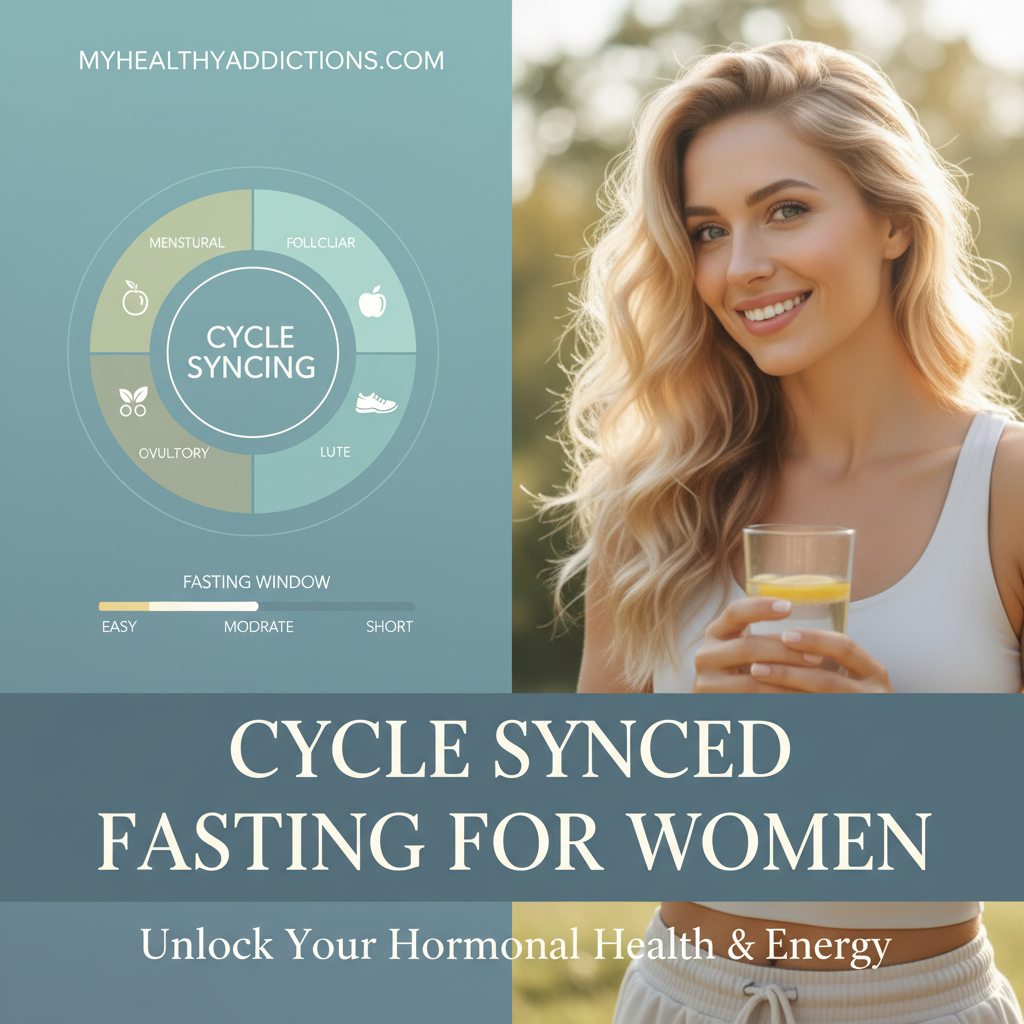
Before you can sync your fasting to your cycle, you need to understand the four phases — and what’s happening hormonally in each one to understand
Your Cycle Is Not a Weakness. It’s a Map.
Check this Try The Cycle-Synced Fasting Dashboard to see which phase you are in and how to adjust your fasting accordingly!
Menstrual Phase (Days 1–5)
Estrogen and progesterone are at their lowest. Your body is doing significant work — shedding the uterine lining, managing inflammation. This is not the time for metabolic stress. Rest, nourish, and keep fasting windows short.
Follicular Phase (Days 6–13)
Estrogen begins to rise. Insulin sensitivity improves. Energy lifts. This is your metabolic sweet spot — the phase where your body is most capable of tolerating and benefiting from longer fasting windows. Cognitively, you may feel sharper and more motivated too.
Ovulatory Phase (Days 14–17)
Peak estrogen, then the LH surge that triggers ovulation. Your body is doing important hormonal work. You can sustain shorter fasts, but this isn’t the time to push. Your energy is high, but your hormones need support, not strain.
Luteal Phase (Days 18–28)
Progesterone rises, preparing for a potential pregnancy. Your metabolism naturally speeds up (you burn roughly 100–300 more calories per day). Hunger increases — and that’s not a failure, that’s biology. Serotonin fluctuates, appetite shifts, and your body increasingly wants warmth and nourishment. This is the phase where strict fasting is most likely to backfire.
Understanding this isn’t just intellectually interesting — it’s operationally useful. Your cycle tells you when to extend your fast, when to ease off, and when to prioritise eating over restricting.
The Cycle-Synced Fasting Protocol
Here’s how to apply this framework in practice. These windows are starting points — adjust based on how you feel, your health history, and in consultation with your healthcare provider.
| Phase | Days | Fasting Window | Focus |
| Menstrual | 1–5 | 12–13 hours max | Rest & nourish. No OMAD(One Meal A Day). |
| Follicular | 6–13 | 15–17 hours | Extend fasts. Metabolic sweet spot. |
| Ovulatory | 14–17 | 13–15 hours | Moderate fasting. Hormones working. |
| Luteal | 18–28 | 12 hours or skip | Prioritise eating. Don’t restrict. |
The core principle: your fasting window should be longest in the first half of your cycle (follicular phase), and shortest — or absent — in the second half (luteal phase).
This isn’t about fasting less overall. It’s about fasting at the right moments so your hormones aren’t working against you. The goal is metabolic flexibility — teaching your body to use fat as fuel — without triggering the stress response that undermines your health.
Why Women Should Fast Differently?
What This Looked Like for me???
Note: This is my personal experience and is not medical advice. Always consult a healthcare professional before changing your diet or fasting routine.
I’d been doing 16:8 religiously for about four months ( it was Feb-June 2024 when I was actually 40). On paper, I was consistent. In practice, by the third week of every month, I was useless. Exhausted. Craving carbohydrates like my life depended on it. My sleep was worse, my mood was volatile, and I kept thinking: why can’t I just stick to this?
Then I came across Dr Mindy Pelz’s work — specifically her book Fast Like a Girl — and something clicked. I wasn’t bad at fasting; I just happened to do the intermittent fasting at the wrong times.
I started tracking my cycle properly — not just period dates, but energy, mood, appetite, sleep quality. I mapped my fasting windows onto my phases for eight weeks. Here’s what changed:
- In my follicular phase, I extended to 16–17 hours and felt sharp, energised, clear. I genuinely looked forward to those mornings.
- Through ovulation, I kept it to about 14 hours — comfortable, not straining.
- In my luteal phase, I dropped to 12 hours and sometimes ate a small breakfast. I stopped fighting my hunger and started listening to it instead.
- During menstruation, I didn’t fast at all for the first two days. I ate nourishing, warm food and slept as much as I could.
After eight weeks, here’s what I noticed: sleep improved significantly. Bloating in my luteal phase dropped. My mood was more stable, particularly that pre-period window that used to derail me. My relationship with food shifted from something I was battling to something I was working with.
I also stopped feeling like I was failing every time I needed to eat.
One caveat: I have a cervical spine condition that means I’m already careful about anything that raises systemic stress. Cycle-syncing wasn’t just about aesthetics for me — it was about not adding inflammatory stress to a body that’s already managing something. That framing — fasting as a tool for health, not punishment — is what made it sustainable
What About Perimenopause and Beyond?
If your cycles are irregular, shortened, or you’re post-menopausal, you can still apply the principle — you just adapt the approach.
For women in perimenopause: track your symptoms rather than calendar dates. Notice when your energy is higher (estrogen-dominant phase equivalent) and when hunger, brain fog, and fatigue increase (progesterone-dominant phase equivalent). Align your fasting windows to those patterns.
For post-menopausal women, Dr Pelz recommends a 5-day fasting cycle: three days of moderate fasting followed by two days of eating freely. This mimics some of the variation your cycle previously provided, without the calendar framework.
In both cases, the central principle holds: metabolic stress needs variation and recovery windows. The body doesn’t thrive on relentless restriction at any life stage.
Common Mistakes Women Make When Fasting
If you’ve been frustrated with fasting results, one of these might explain why:
- Fasting the same hours every single day, regardless of cycle phase
- Breaking a fast with high-sugar foods, alcohol, or seed oil-heavy ultra-processed food
- Combining aggressive fasting with high-intensity workouts in the luteal phase — a cortisol double-hit
- Ignoring warning signs: hair thinning, irregular periods, persistent anxiety, disrupted sleep
- Comparing your results to male partners, colleagues, or influencers whose biology doesn’t apply
- Believing that more hours always means more results
If fasting is making you feel worse over time — not just briefly uncomfortable but genuinely worse — that’s feedback. Your body is telling you the timing or duration isn’t right, not that you’re broken.
Start Where You Are
Cycle-synced fasting requires more attention than a fixed daily rule. But it’s far less effort than spending months fighting your own hormones, wondering why you feel awful doing something that’s supposed to help.
Start simply: just track your cycle for one month. Notice your energy, hunger, sleep, and mood across the four phases. You don’t need to change anything yet — just observe. That data is more valuable than any protocol you can follow.
When you’re ready to layer in fasting, start with the follicular phase. Try 15 hours. See how you feel. Let your body teach you rather than forcing it to comply.
BONUS–> Cycle tracking dashboard!